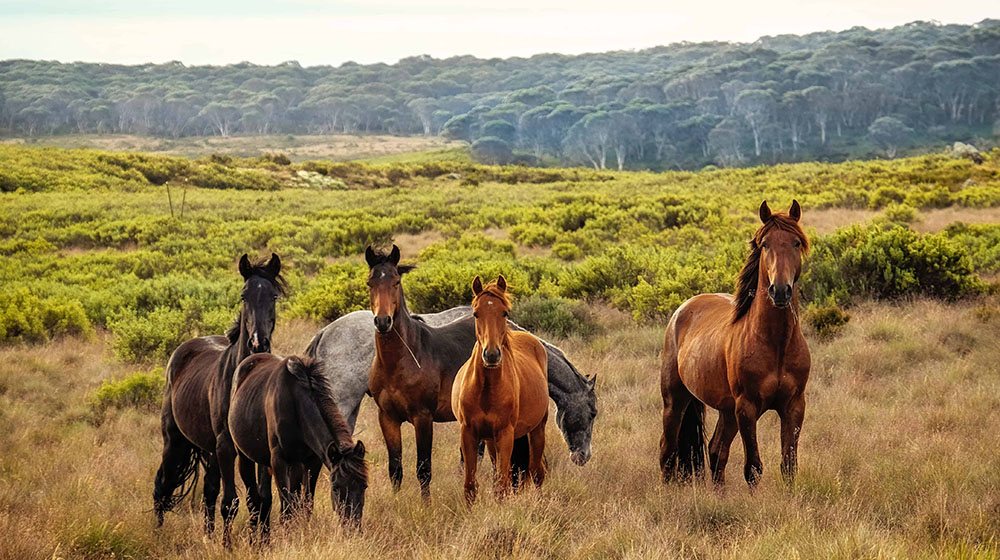
Mustang horse: symbol of freedom and power
Por Horse TV
02.02.2026
NEWS | Lifestyle
When we talk about the Mustang horse, we tend to think of an icon of the American West, of freedom and endurance. However, from an equestrian and technical point of view, the Mustang is much more than a romantic image: it is one of the best living examples of natural selection applied to the domestic horse.
Far from being a closed breed, the Mustang horse is a feral population with extraordinary genetic diversity, whose value lies precisely in its functional adaptation, biomechanical efficiency and impressive physical and mental durability.
Genetic origin: a melting pot of functional bloodlines
Mustangs are descended from horses introduced to America by the Spanish in the 16th century, mainly of Iberian and North African origin. Over the centuries, this genetic base was enriched with contributions from European colonisation horses, Quarter Horses, Thoroughbreds and, of course, Spanish horses.
The result is a population with great morphological variability, but subjected for generations to extremely harsh selection pressure: only the most efficient, most resistant and best adapted individuals survived.
From a zootechnical point of view, the Mustang is a perfect example of functionality through environmental selection.
Conformation and biomechanics: efficiency over spectacle
Although there is no ‘single type’ of Mustang horse, most share a number of functional characteristics, including a height ranging from 1.40 to 1.55 metres, a short, sturdy back, well-attached loins, dry limbs, strong joints and compact feet.
Their movement does not seek the amplitude or spectacularity of classical dressage, but rather economy of movement, balance and endurance. These horses are designed to cover many kilometres with the least possible energy expenditure, maintaining the integrity of their locomotor system for years.
The Mustang's hoof: a model for modern podiatry
One of the most studied aspects of the Mustang is the exceptional quality of its hooves. Living without shoes and travelling over hard and varied terrain, they develop dense and compact walls, thick soles, functional frog and an optimal balance between growth and wear.
It is no coincidence that the Mustang horse is a constant reference in natural shoeing and physiological trimming.
Ethology and behaviour: the mind of the feral horse
A feral or wild horse is the result of domestic horses that have adapted to living in freedom. This is why the Mustang retains a mental structure very similar to that of the primitive horse.
They have a great ability to read their surroundings and a highly refined survival instinct, so their response to a potential threat will always be swift. They understand and respect social hierarchies and have a great spatial and social memory.
This translates into a simple conclusion: their training must be slow and consistent. A bond must be established with them without subjugating or forcing them, accompanying their character and giving them all the time they need.
Current management and adoption programmes
In the United States, Mustangs are protected by the Wild Free-Roaming Horses and Burros Act. The management of these populations poses complex challenges, such as population control, ecosystem preservation, and adoption and re-education programmes.
Many of these horses end up performing excellently in disciplines such as endurance riding.
The Mustang is not just a symbol: it is a manual of biomechanics, adaptation and efficiency written by nature. To study it is to understand how a horse should function when every structure has a purpose and nothing is superfluous. A reminder that, in the equestrian world, true perfection is often functional, not aesthetic.










_v2.svg)
_v2.svg)









_v2.svg)